
Commercial & Industrial Properties Singapore - Sales & Rental
(65) 6100 8123

OPPORTUNITY FOR DISCERNING INVESTORS Invest in Singapore’s Food Future – High-Growth, Low-Risk Asset
Food-manufacturing Asset | Sector Fundamentals | Demand Drivers
The investment framing: a food-manufacturing asset built for the next cycle
The investment thesis presented for Gourmet Xchange is anchored in two realities:
-
Singapore’s food manufacturing sector is large, export-oriented, and growing, and
-
modern food businesses increasingly require advanced, efficient, well-located facilities—creating structural demand for high-spec food industrial space.
Gourmet Xchange is positioned as a strategic response: the largest strata-titled food hub in Singapore, centrally located, engineered for logistics performance, and differentiated by a heritage + lifestyle ecosystem that’s uncommon in industrial developments.
Sector fundamentals
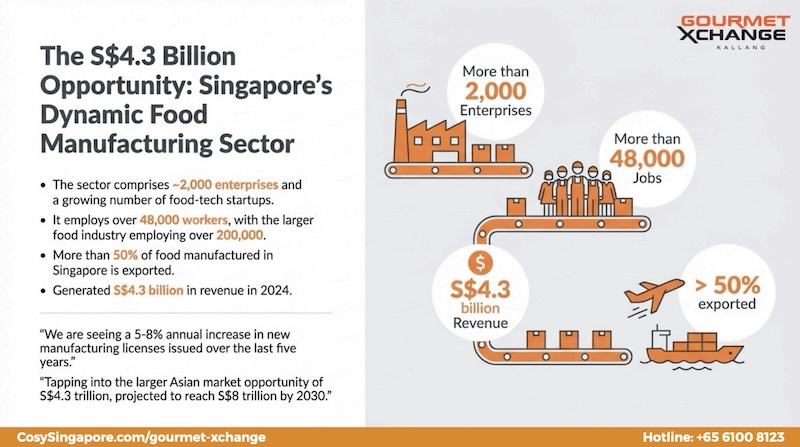
As of 2024, the sector is described with:
-
~2,000 food manufacturers (plus a growing food-tech ecosystem),
-
S$4.3 billion in revenue,
-
48,000+ workers employed,
-
>50% of food manufactured exported,
-
5%–8% annual increase in new manufacturing licenses over the past five years (as stated).
Regionally, the broader Asian food market is cited as growing from ~US$4.3 trillion to ~US$8 trillion by 2030, supporting long-run opportunity for Singapore-based manufacturers leveraging the “Made in Singapore” quality reputation.

Demand drivers that matter to investors (and landlords)
1) Changing consumer behaviour
Growth in online shopping, ready-to-go meals, and diverse cuisines increases demand for central kitchens and scalable production.
2) Manpower shortages push productivity upgrades
Businesses need facilities that support efficiency, automation, and smoother logistics—exactly what the ramp/driveway/loading design targets.
3) Higher-value roles require better environments
Amenity-rich, wellness-integrated industrial environments become an advantage for tenants competing for skilled talent—supporting occupancy quality.
Asset differentiation (why this is not “just another food factory”)
From an investor’s perspective, differentiation supports tenant attraction and resilience:
-
Central location within Kolam Ayer industrial estate (designated food zone) with strong expressway and MRT access.
-
Logistics-first engineering (40-footer ramp-up to L3, 16m driveway, dedicated and common loading strategies, rooftop heavy vehicle parking).
-
Lifestyle and public realm (river promenade, fitness corner, sky garden, central plaza; fenceless public accessibility) strengthening “destination” value.
-
Heritage Terrace scarcity (last TS factory cluster) creating a unique product class inside the development.
-
Sustainability positioning (Green Mark Platinum SLE target; adaptive reuse lowers embodied carbon) supporting future-proofing.

A practical investor lens (how investors often underwrite this type of asset)
In strata industrial investments, many buyers focus on:
-
tenant depth (how many types of users can fit),
-
specification edge (features that reduce operational friction),
-
location stickiness (centrality and transport),
-
long-term relevance (sustainability, talent environment, compliance readiness),
-
exit narrative (differentiation, landmark status, scarcity).
Gourmet Xchange’s design and positioning directly speak to these points, especially by addressing operational pain (truck queuing, container access, loading competition) and by creating a more modern work environment aligned to evolving workforce needs.
A practical investor lens (how investors often underwrite this type of asset)
|
Driver |
Why it matters |
How Gourmet Xchange responds |
|---|---|---|
|
Food sector growth |
More operators and expansion |
Large-scale strata-titled hub targeting food users |
|
E-commerce & ready meals |
More central kitchens |
Central location + scalable unit formats |
|
Manpower constraints |
Need efficiency + automation |
Ramp access, driveway width, loading strategy, height |
|
Talent competition |
Better workplace environments |
Waterfront promenade, sky garden, plaza, amenities |
|
ESG & future-proofing |
Lower carbon + efficiency |
Green Mark target + adaptive reuse + energy/water features |
Investment Advantages Summary:
-
Strong sector fundamentals (2024 stats) support long-run tenant demand.
-
Differentiated “logistics + lifestyle + heritage” ecosystem strengthens leasing and resale narrative.
-
Centrality + connectivity support operational stickiness for tenants.
-
Sustainability targets + adaptive reuse support future relevance.
CosySingapore.com
Connecting People with the Right Space
We look into industrial and commercial properties in Singapore. Contact us for honest, informed advice on commercial and industrial property solutions
QUICK LINKS
CONTACT
Desmond Tan
Licensed Real Estate Consultant
CEA Registration No: R007497J
Phone: +65 6100 8123
Email: Cosysingapore@gmail.com
Web Site: www.cosysingapore.com
Office Hours:
Monday – Sun: 8:30am – 8:00pm
Public Holidays: By appointment
All information is provided in good faith based on available project data and is subject to change by the developers or relevant authorities. Floor plans, specifications and prices are indicative and subject to final confirmation. This page does not constitute a formal offer. Buyers are advised to conduct independent due diligence and seek professional legal advice before making any purchase decision.