
Commercial & Industrial Properties Singapore - Sales & Rental
(65) 6100 8123

Food Factory Unit Layouts & Specifications at Gourmet Xchange
Two distinct zones: Heritage Terrace (Block A, B1 Food with F&B Outlet) and The Xchange main block (Block B, B2 Food)
A Unit Mix Designed for Real Operations (not generic floor plates)
Gourmet Xchange is designed around a practical truth in food businesses: different operators scale differently. Some start lean and grow quickly; others require immediate consolidation (central kitchens, large batch production, bulk storage, automation lines). The unit strategy therefore focuses on:
-
two main categories of production units in The Xchange (Standard and Deluxe),
-
modular flexibility (ability to combine units),
-
a unique Heritage Terrace vertical model for integrated “produce + office/R&D + customer-facing” operations.
| Block | Unit Type | Quantity | Typical Size | Primary Use |
|---|---|---|---|---|
| The Xchange | Standard Units | 255 | Up to 393 sqm (4,230 sq ft) | B2 Food Production |
| The Xchange | Deluxe Units | 6 | Up to 756 sqm (8,137 sq ft) | B2 Food Production |
| Heritage Terrace | Terraced Units | 8 | Multi-storey integrated | B1 Food / F&B / Office |
Gourmet Xchange is planned around a simple idea: food operators need efficient flow—delivery in, processing, packing, cold storage, dispatch out—without fighting the building. That’s why the development offers a clear “menu” of unit types across two distinct zones: Heritage Terrace (Block A, B1 Food) and The Xchange main block (Block B, B2 Food), with layouts designed for production efficiency, compliance readiness, and future scalability
Food Factory Deluxe Units at XChange Main Block B
Larger Units at Level 1 to Level 3

Food Factory Deluxe Units at Level 1

Food Factory Deluxe Units at Level 2

Food Factory Deluxe Units at Level 3

Level 1 to Level 3 | Type C – B2 (Food) Deluxe Units (45 units) | 6,135 to 8,159 sqft | 570–758 sqm
Type C adds scale and flexibility, typically presented with lower + upper floor planning, including mezz/office potentialand a more generous production plate. This is suited for operators who want to centralise multiple product lines, add R&D kitchens, or expand cold-room capacity without relocating
Food Factory Standard Units at XChange Main Block B
Smaller Units at Level 4 to Level 9

Food Factory Standard Units at Level 4

Food Factory Standard Units at Level 5

Food Factory Standard Units at Level 6

Food Factory Standard Units at Level 7

Food Factory Standard Units at Level 8

Food Factory Standard Units at Level 9

Level 4 to Level 9 | Type B – B2 (Food) Standard Units (210 units) | 3,175 to 4,230 sqft | 295 – 393 sqm
Type B is the workhorse category—right-sized for SMEs and growing brands. The typical plan shows a clean split between production zone and ancillary area, paired with a dedicated loading bay. It’s a straightforward footprint for setting up logical process lines (wash → prep → cook → chill → pack), while leaving enough depth for future equipment upgrades.
The Xchange: Standard & Deluxe Production Units (B2 Food)
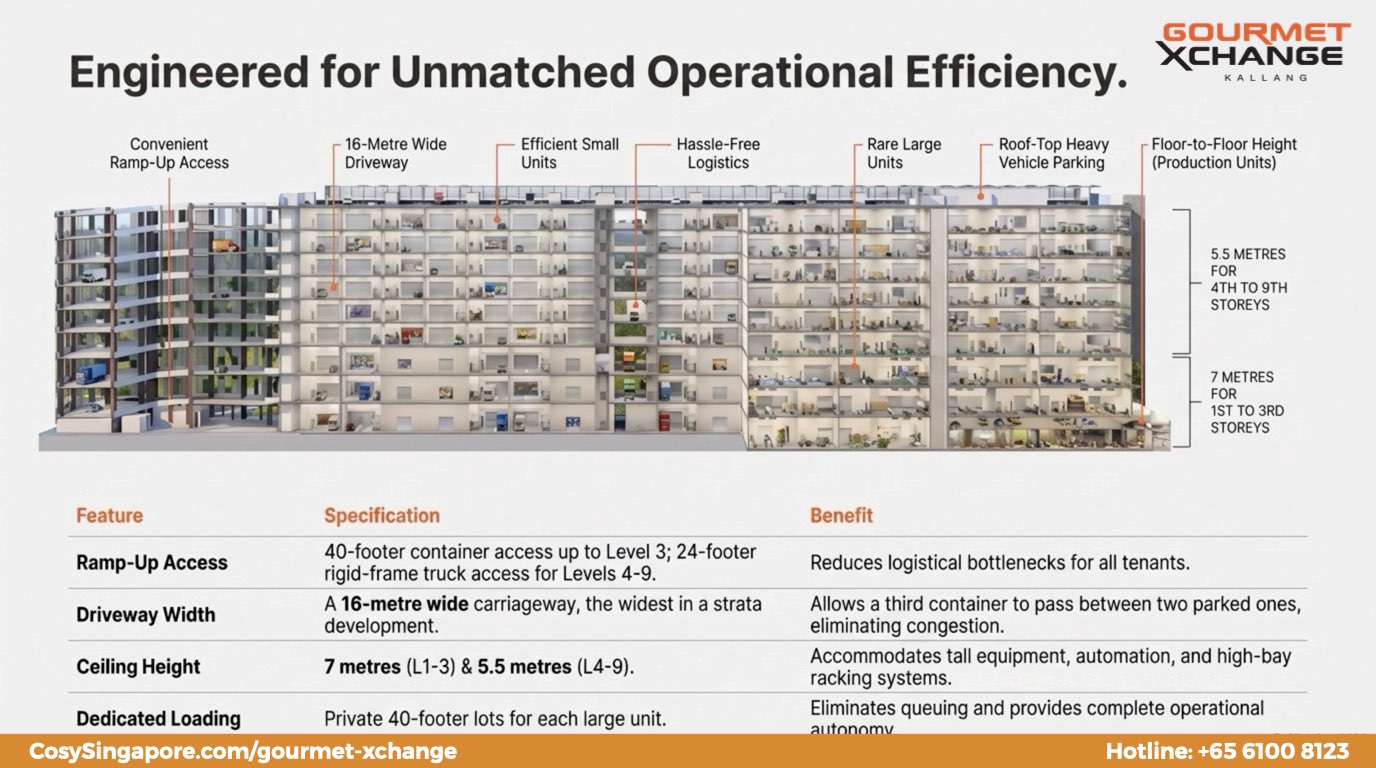
The Xchange is a nine-storey facility with production units designed for food manufacturing and related uses (under B2 Food zoning). Within it:
-
Standard units are offered up to ~393 sqm (~4,230 sq ft).
-
Deluxe units are offered up to ~756 sqm (~8,137 sq ft).
-
The development emphasises rare larger floorplates within a strata-titled format, helping larger operators consolidate in a central location rather than splitting across multiple sites.
Design Advantage: Sunken Floors
All production units are described as featuring sunken floors, supporting operational needs typical in food production environments.
Modularity Advantage: Scale without Relocating
A recurring operational pain point in growing food businesses is disruption from relocation. Gourmet Xchange’s modular approach supports combining units to create larger contiguous spaces, enabling expansion while staying within the same address and logistics ecosystem.
Ground-floor Visibility: Glass Frontages for Brand Presence
A standout operational-and-marketing advantage is that ground-floor units feature glass frontages, enabling product display and brand visibility alongside production. For certain businesses—specialty foods, boutique manufacturing, B2B sampling, visitor engagement—this can shorten the distance between “factory” and “market.”
Heritage Terrace (F&B and B1)
First Adaptive Reuse Project of its Kind

Heritage Terrace: the “vertical integration” business model (B1 + F&B)
The Heritage Terrace comprises 8 terraced units and is planned with a floor-by-floor usage model:
-
1st storey: Restaurants / F&B
-
2nd storey: flexible (Business 1 (Food) / Office / R&D)
-
3rd storey: Business 1 (Food) / Central Kitchen operations
This is powerful for businesses that want:
-
a customer-facing flagship while keeping production close,
-
an R&D lab upstairs from operations,
-
a single operational “stack” rather than multiple scattered leases.
It is also attractive for investors seeking “story + scarcity”: a preserved heritage typology with functional modern use.

Unit Design & Configuration Advantages:
-
Diverse Portfolio: Solutions for every business size and type, from 710 sqft to over 5,300 sqft.
-
Move-In Ready: Fitted with ceilings, lighting, flooring, and AC, minimizing renovation time/cost.
-
Abundant Natural Light: Strategic design maximizes daylight in all units, enhancing well-being.
-
Unique Product Innovation: “Modern Shophouse Offices” offer a rare blend of heritage charm and modern convenience.
-
Flexible Layouts: Options for open-plan collaboration, private suites, or unique split-level creative spaces.
-
Premium Finishes: High-quality specifications ensure a prestigious and durable work environment.
CosySingapore.com
Connecting People with the Right Space
We look into industrial and commercial properties in Singapore. Contact us for honest, informed advice on commercial and industrial property solutions
QUICK LINKS
CONTACT
Desmond Tan
Licensed Real Estate Consultant
CEA Registration No: R007497J
Phone: +65 6100 8123
Email: Cosysingapore@gmail.com
Web Site: www.cosysingapore.com
Office Hours:
Monday – Sun: 8:30am – 8:00pm
Public Holidays: By appointment
All information is provided in good faith based on available project data and is subject to change by the developers or relevant authorities. Floor plans, specifications and prices are indicative and subject to final confirmation. This page does not constitute a formal offer. Buyers are advised to conduct independent due diligence and seek professional legal advice before making any purchase decision.